Shahzada Yaqoot ENG.355
The theme for this week: Powerlessness

What all did we discuss this week?
The Fictional works of four authors were discussed. In perusing the works of other writers, we are often fascinated by their approach to everyday life and their way of expressing their thoughts. Their pens paint the pictures by giving words to their imagination that they narrate so colorfully. In doing so, they use their creativity and out-of-the-box thinking abilities to pick up their subjects, and create a plot to develop their stories. In doing so, they imagine or adopt the persona of their characters and perform virtual acts on the playgrounds of their minds. The themes based on fictional writing are important as they cause the readers mind become engrossed in the fiction. Such mental involvement expands readers imagination and gives them an ability to think creatively, find new ideas, resolve problems and gives them ability cope with life’s given situations. Thus the hypothesis inherent in fictional literature is not useless but has a specific purpose teaching, preparing and enlightening the minds of readers.

Fiction as a genre.
In fictional writing, characters can act and behave without the limitation of rationale. Since the plot is imaginary, the authors can manipulate it in any direction. However, there is always a purpose behind the writing. The story’s plot, progression, and conclusion are often dramatically orchestrated to shock the reader, keep them engrossed, and leave them thinking about why the story ended the way the author did. If an author succeeds in accomplishing these three tasks, he would be successful in writing and leaving a lasting impression on the readers. Fiction also teaches empathy to the readers, through the implied message. It helps develop compassion, It develops a liking for reading and give expansion to the knowledge bank especially enhancing the readers vocabulary. https://buffer.com/resources/reading-fiction/#:~:text=Fiction%20is%20a%20uniquely%20powerful%20way%20to%20understand,of%20reading%20fiction.%201.%20Empathy%3A%20Imagining%20creates%20understanding




Classroom activity:
Q1. Write a 500 word essay on Faust and discuss elements of fiction the author has incorporated in writing this piece.
Q2. Akhmotova wrote specifically about a situation she observed while waiting outside the jail. Who was she addressing, and whom had she come to meet at the German Prison.
Successful writers leave an impression upon their readers and evoke a literary hunger in them. Their followers acknowledge to what extent the author stimulated their minds in deciphering the true meaning, purpose, or the inherent message that the author may have embedded into the plot of the story in a subtle way. This deliberate probe through the perusal of literary works, drawing any inference from the contents, and correctly interpreting the core purpose is the essence of studying literature.
Thus, after reading a specific work of an author, it is up to the reader to fathom it and interpret it. But, of course, every reader interprets subjectively, and thus interpretations will always be different. It is only after extensive sampling that a collaborative consensus forms.
https://blog.reedsy.com/short-story-ideas/
Class assignment: Students, please create a 500-word fictional story on a topic of your choice.
Powerlessness:
The discussion on the topic of powerlessness can solicit many views. Each reader drew an inference and responded subjectively. Of the four texts studied, two were poems, and two were in prose. Kafka’s Metamorphosis, the prose, was the first read. This writer found the story quite humorous. The moment one reads the line that its protagonist had over nightly transformed from a perfect human being into a bug, signals the reader that it was a fiction. However, it is the author’s diction that makes it interesting. Franz Kafka narrates the feelings and struggles of the newly formed bug before he flashes back into his previous life. It is only through the progression of the story that Gregor, the human who turned into a bug, is introduced, explaining that who he was, where did he work, what was his job, who managed him, why work there, why couldn’t he leave and work elsewhere. The author subtly discloses answers to these questions through the development of this story. The central idea of the story is to portray how powerless Gregor was after his transformation into a bug. Gregor’s helpless was both objectives where his body had actually changed and the subject by feeling weak, embarrassed, and restricted. Other factors leading to powerlessness are in the following diagram.

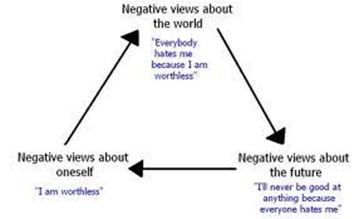
Gregor who was shocked, angry, embarrassed was sort of still in self-denial and did not want to accept the fact that his life had changed for ever. The following chart explains Gregor’s state of mind.
Hopelessness-theory-of-depression. PSU.Edu.
https://www.google.com/url?sa=i&url=https%3A%2F%2Fsites.psu.edu%2Faspsy%2F2014%2F09%2F28%2F

Powerlessness in Popular Culture
Franz Kafka defines Gregor’s struggle to change his side on the bed and narrates how helpless he was. Something that he could do with just springing up- was now a struggle. This is evocative of many people worldwide who have become handicapped by illness or accidents. Learning from Kafka’s definition of powerlessness and seeing the people we know experiencing it is quite heart-rending. These people go through the struggles of changing their sides, moving their limbs, getting off the bed, walking to the restrooms are just a few activities that would remind a person how powerless they were.
Experiencing powerlessness also leads to acute frustration and depression. One becomes dependent on others for everyday activities. For example, imaging a person wanting to drink water, the water bottle is just next to them, but the person cannot just grasp and drink it unless an external help comes to help in holding the glass to the thirst person’s lips. Therefore, powerlessness also leads one to hopelessness. When an expectation fail, it ensues hopelessness. Desperation leads people into depression, which makes a person go into sadness, inferiority complex, loneliness, and acute anxiety. The following resource explains the mechanism of transitions from powerlessness to hopelessness and its consequences.
The present-day experiences that we can associate with powerlessness are numerous. No matter where we look, we find powerlessness manifesting in people’s lives or circumstances. COVID-19 that thrust illness upon millions of people worldwide made people hopeless and in result, powerless. Even those who had all the resource to buy the best medical treatment could not save themselves from the clutches of death. It significantly equates to Goethe’s Faust, where he is all accomplished and lacks nothing, instead strives for more knowledge and power, finally finds himself powerless. It cannot get for which he even sought the help of the conniving devil. Faust experienced powerlessness in an ironic form. He thought he could get anything but became handicapped by events he orchestrated by his intellect. Intellect that is an ideological state apparatus could not help him. Faust is a excellent parallel to the many millionaires of this world who die seeking medical treatment that could rid them of their disorders. Just as Faust’s intellect and power could not save him, money cannot save human lives by wealth and accomplishments alone.

Study: COVID-19 caused nearly 1M extra deaths in 29 wealthy countries
Classroom Activity.
Q1. What is the major difference between the objective powerlessness and Subjective powerlessness.
Q2. Discuss symptoms of inferiority vs the consequences of fatalism.
Anna Akhmatova’s the Requiem, is about women’s powerlessness. The German Guards’ maltreating women standing for hours prompted her to vent out her deep emotions of powerlessness. That equates to the thousands of migrants coming to the US borders to seek an entry, and whose children the authorities separate under the premise of providing safety to the young. But the very act of US authorities also engenders extreme emotional stress for the mothers at the taking away of their children. Ann Akhmatova laments about this RSA in her Poem the Requiem, which is analogous to what is going on the borders of Southwestern borders of the United States.
Likewise, we can also see the similarity between the plight of “Undocumented Aliens” and their submissive characters to the decision that the Arab prisoner makes in Albert Comus’s short story “The Guest.” The protagonist Daru, a school teacher, facilitates a prison to abscond and save his life, at least for a while. The prisoner decides contrary to Daru’s expectations by willingly submitting himself to the authorities waiting for his arrest. Daru feels that by allowing the prison free will, he thrust him into the hands of death. Daru laments that he could not save a brother. But see this from the prison perspective, we conclude that the Arab was depressed, had given up hope and thus felt powerless against the RSA of the authorities. He is not forgetting that the prisoner also was influenced by his ideological State Apparatus (ISA) that Althusser also defined in the above-stated reference of Stephen Greenblatt’s essay. ISA is all the negative notions that a person subjectively adopts or experiences. The prisoner in Comus’s story that he captioned as “The Guest” suffers from many factors of ISA (illustrated above).
The current situation of the undocumented aliens is analogous of the Arab prisoner. The unlawful stay inherent in their status robs them of many state and federal programs. When things get tough, they get arrested, put in prison for a while, and deported to their home countries. Their powerlessness in avoiding deportations and fighting for their right to work and live in the United States by legalizing their status, is often not heard nor feasible because of the resources needed. In the end, they submit themselves to the authorities for deportation, or they wander away towards the nearby countries.
Powerlessness is thus a worse misfortune that a human can endure. As explained here, the four authors and the message inherent in each of their work have a direct equivalent in our present-day surroundings. Few examples of this equation are quoted here, but let us challenge ourselves to check out how many more situations we can identify to equate them to the four versions of the authors studied. In a nutshell, can we all find ten cases in each that represent the ensuing powerlessness resulting from the following situations:-
- Gregor’s physical transformation, illustrated by Kafka’s in Metamorphosis.
- The irony of powerlessness resulting from self-destructive behavior as elaborated in Goethe’s Faust.
- The extreme description of powerlessness proving “the might is right,” as experienced by Anna Akhmatova in her poem “Requiem.”
- The Powerless person running out of options, as portrayed in the short story “The Guest” by Albert Comus.
These culturally diverse works of the four authors teach us that people are a product of nature and nurture. The values imbibed into a person’s up bringing form a character and ultimately a worldview. Everyone, even when sharing the culture, will not have similar values. This gap becomes, even more, when people interact across the religious, cultural, and ethnic boundaries. And since America hosts over 350 different ethnicities, can we look around and find if there any cultural or value-based boundaries that exist within the sphere of our influence? And what can we do to dim those boundaries, or can we ever erase those off altogether?
What all did we discuss this week?
The Fictional works of four authors were discussed. In perusing the results of other writers, we are often fascinated by their approach to everyday life and their way of expressing their thoughts. Their pens paint the pictures by giving words to their imagination and narrate it colorfully. In doing so, they use their creativity and out-of-the-box thinking abilities to pick up their subjects and create a plot to develop their stories. In doing so, they imagine or adopt the persona of their characters and perform virtual acts on the playgrounds of their minds.


Study: COVID-19 caused nearly 1M extra deaths in 29 wealthy countries
Anna Akhmatova’s the Requiem, is about women’s powerlessness. The German Guards’ maltreating women standing for hours prompted her to vent out her deep emotions of powerlessness. That equates to the thousands of migrants coming to the US borders to seek an entry, and whose children the authorities separate under the premise of providing safety to the young. But the very act of US authorities also engenders extreme emotional stress for the mothers at the taking away of their children. Ann Akhmatova laments about this RSA in her Poem the Requiem, which is analogous to what is going on the borders of Southwestern borders of the United States.
Likewise, we can also see the similarity between the plight of “Undocumented Aliens” and their submissive characters to the decision that the Arab prisoner makes in Albert Comus’s short story “The Guest.” The protagonist Daru, a school teacher, facilitates a prison to abscond and save his life, at least for a while. The prisoner decides contrary to Daru’s expectations by willingly submitting himself to the authorities waiting for his arrest. Daru feels that by allowing the prison free will, he thrust him into the hands of death. Daru laments that he could not save a brother. But see this from the prison perspective, we conclude that the Arab was depressed, had given up hope and thus felt powerless against the RSA of the authorities. He is not forgetting that the prisoner also was influenced by his ideological State Apparatus (ISA) that Althusser also defined in the above-stated reference of Stephen Greenblatt’s essay. ISA is all the negative notions that a person subjectively adopts or experiences. The prisoner in Comus’s story that he captioned as “The Guest” suffers from many factors of ISA (illustrated above).
The current situation of the undocumented aliens is analogous of the Arab prisoner. The unlawful stay inherent in their status robs them of many state and federal programs. When things get tough, they get arrested, put in prison for a while, and deported to their home countries. Their powerlessness in avoiding deportations and fighting for their right to work and live in the United States by legalizing their status, is often not heard nor feasible because of the resources needed. In the end, they submit themselves to the authorities for deportation, or they wander away towards the nearby countries.
Powerlessness is thus a worse misfortune that a human can endure. As explained here, the four authors and the message inherent in each of their work have a direct equivalent in our present-day surroundings. Few examples of this equation are quoted here, but let us challenge ourselves to check out how many more situations we can identify to equate them to the four versions of the authors studied. In a nutshell, can we all find ten cases in each that represent the ensuing powerlessness resulting from the following situations:-
- Gregor’s physical transformation, illustrated by Kafka’s in Metamorphosis.
- The irony of powerlessness resulting from self-destructive behavior as elaborated in Goethe’s Faust.
- The extreme description of powerlessness proving “the might is right,” as experienced by Anna Akhmatova in her poem “Requiem.”
- The Powerless person running out of options, as portrayed in the short story “The Guest” by Albert Comus.
These culturally diverse works of the four authors teach us that people are a product of nature and nurture. The values imbibed into a person’s up bringing form a character and ultimately a worldview. Everyone, even when sharing the culture, will not have similar values. This gap becomes, even more, when people interact across the religious, cultural, and ethnic boundaries. And since America hosts over 350 different ethnicities, can we look around and find if there any cultural or value-based boundaries that exist within the sphere of our influence? And what can we do to dim those boundaries, or can we ever erase those off altogether?
Classroom Activity:
Q1. Write a 500 words essay explaining how COVID-19 led thousands of people into “hopelessness.”
Q2. Did the high number of suicides’ during the COVID -19 resulted from Objective helplessness or as a direct result of subjective hopelessness, and if so what specific hopelessness lead people to terminate themselves?



 Shahzada Yaqoot
Leave a comment